
What Pool Luck and Orphan Rates Mean for Your Payouts
Pool luck is how far a pool's recent block-finding rate sits from the rate its hashrate implies, and an orphan block is one that gets found but never makes it into the chain, so the coins it would have paid are never distributed. Neither is visible in your hashrate readout, and both decide whether your payout arrives today or next week. At 1,000 TH/s the same machines produce 0.00047353 BTC a day, worth $40.39 at $85,294 per BTC, but only if the rounds they are mining in actually confirm.

Key takeaways
- 1,000 TH/s earns 0.00047353 BTC a day at difficulty 132.76 T, or $40.39 gross and $38.77 after the listed 4% on the block reward.
- Under PPS+ the block-reward component is settled hourly at current difficulty, so pool luck and orphan exposure are carried by the pool rather than by the miner.
- Under PPLNS a payout is allocated after 6 confirmations across the last 5 difficulty rounds, so a slow or unlucky window shows up directly in your balance.
- The listed 4% versus 2% gap at 1 PH/s over 30 days is $24.23, which is the price of that transfer and the number to compare against your own variance.
What luck actually measures
Hashrate sets an expectation and luck measures the gap between that expectation and reality. If a pool holds enough hashrate to expect one block an hour, then a stretch of 70 minutes without a block is not a fault; it is an ordinary deviation, and a stretch of 40 minutes is the other side of the same coin. Luck is the accounting for those deviations, usually expressed as how much of the expected work in a period actually arrived. It is not a property of your hardware and it is not a property of the coin.
The number that makes luck concrete is the expected block interval. At a difficulty of 132.76 T the network hashes at an implied 950.3 EH/s and mints 450 BTC a day across 144 blocks, so a pool holding a tenth of the network's hashrate expects about one block every ten minutes. A pool holding one percent expects roughly 1.44 blocks a day, which means a full day with two blocks and the next with one is exactly what the mathematics predicts.
Where orphan blocks enter the picture
An orphan block was found and then displaced by a competing block on a longer chain, so the reward attached to it is never payable. It is a rare event at the level of a single miner and a routine one at the level of a pool, because a pool produces many blocks and fractions of a percent of them are expected not to survive. What matters for your payout is not the frequency but the accounting rule that follows it.
Under PPS+, the block-reward component is settled on a per-share basis and credited hourly at current difficulty, so the coin from a displaced block does not come out of your balance. Under PPLNS, reward is distributed from the blocks that reach 6 confirmations inside the last 5 difficulty rounds, so a displaced block simply contributes nothing to that window and the round's payout is smaller. Same event, two different places to land.
The two exposures side by side
Both columns describe the same 1,000 TH/s of hardware at the same difficulty. The difference is entirely in who holds the timing and validity risk.
| Term | What it means | PPS+ | PPLNS |
|---|---|---|---|
| Block interval | Gap between the pool's blocks | Irrelevant to hourly credit | Visible directly in the balance |
| Orphan block | Found but not in the chain | Absorbed by the pool | Reduces that round's distribution |
| Listed rate | Fee on the payout components | 4% block reward, 2% fees | 2% on both together |
| Monthly charge | Cost of the arrangement | $48.47 | $24.23 |
| Monthly gross | 0.014206 BTC at this hashrate | $1,211.68 | $1,211.68 |
Note the last two rows together, because that is the whole trade. The exposed method keeps an extra $24.23 a month at this size, and the difference is not a discount or a bonus; it is the price attached to carrying an exposure that the other method has removed.
Worked example
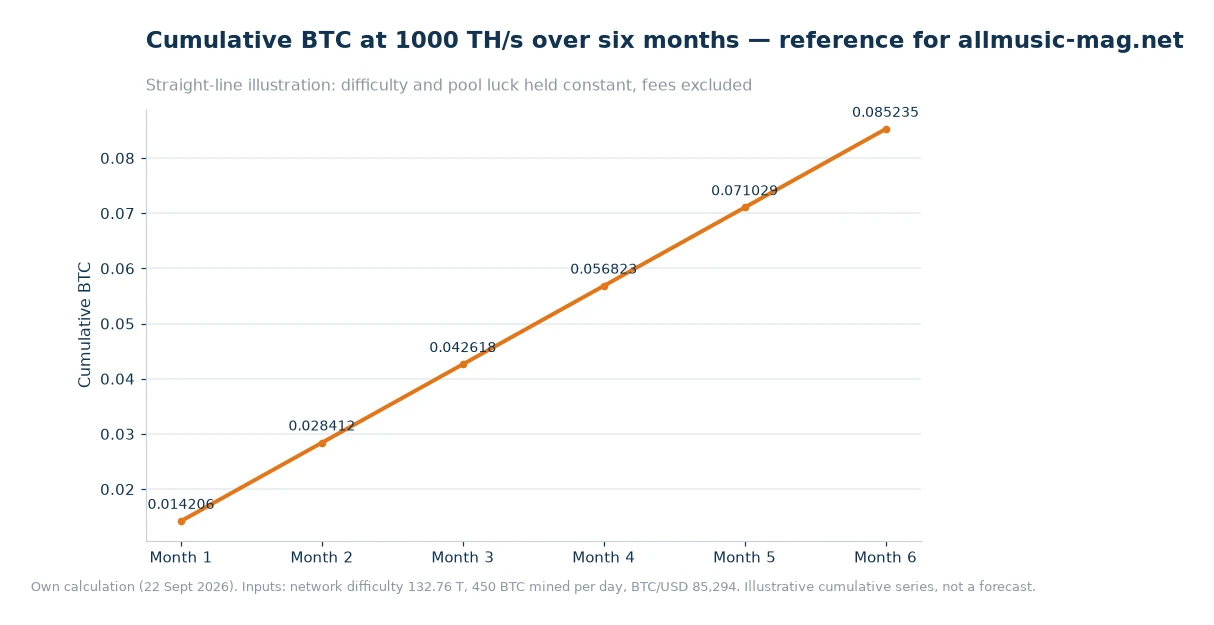
Take 1,000 TH/s and price the exposure over a six-month run at today's difficulty and a $85,294 BTC price.
- Output per TH/s per day is 0.0000004735 BTC, so 1,000 TH/s yields 0.00047353 BTC a day.
- That is $40.39 gross a day, and 0.00001973 BTC an hour, or about $1.68.
- A 30-day month produces 0.014206 BTC, worth $1,211.68 gross.
- The listed 4% on the block-reward component takes $48.47 and leaves $1,163.21 net.
- Six months at this difficulty accumulates 0.085235 BTC, about $7,270, before fees.
- A window that comes in 10% short on luck costs roughly $121.17 of expected income in that month, which is the exposure PPLNS places on the miner and PPS+ does not.
Watching luck on a live page
Luck is only useful as a number if you can read it while it is happening. Three figures on the ViaBTC Mining Statistics page do that job: the Pool Hashrate, which sets the expected block interval; the difficulty, which sets the value of each block; and the recent block list, which lets you compare what arrived with what was expected. A pool running behind expectation for a few hours is ordinary. A pool running behind for a week with its Pool Hashrate flat is a different reading and worth a question.
Pair that habit with two others. Keep a record of daily credits rather than only of hardware uptime, so a variance shows up as a number instead of a suspicion, and use a Profit Calculator to translate any shortfall into dollars before deciding it matters. When the month's credits are reconciled, holding the income inside a multi-currency wallet under the same account makes the comparison between expected and credited much quicker to run.
Frequently asked questions
Can I avoid pool luck entirely?
Not on a mining pool, but you can move the exposure: PPS+ settles the block-reward component hourly at current difficulty, which places the round-to-round variance on the pool rather than on your balance.
How often do orphan blocks happen?
Rarely for any single block and routinely across a pool's output, which is why the accounting rule that applies to displaced blocks matters more than the frequency itself.
Does a low-luck month mean the pool is performing badly?
Not by itself. Compare the Pool Hashrate and the recent block list against the interval those figures imply before drawing any conclusion about performance.
Measure variance before you manage it
Record a month of daily credits for one machine and calculate the spread between the best day and the worst. If that spread is small next to the $24.23 a month you would pay for hourly settlement at this scale, the exposure is theoretical and the lower listed rate is the better trade. If a single quiet window costs more than a month of the difference, the transfer is cheap and the decision is easy in the other direction. Either way, the choice should follow a measurement rather than a preference, and it should be reviewed when difficulty takes its estimated +1.90% step or when the fleet grows.
Inputs read 22 Sept 2026: difficulty 132.76 T, implied network hashrate 950.3 EH/s, 3.125 BTC per block at 144 blocks a day for 450 BTC of daily issuance and $85,294 per BTC, alongside the listed 4% and 2% rates on the pool's schedule[1]. The six-month series assumes a flat difficulty and no luck effect, and both assumptions are stated so the chart reads as an illustration of the method rather than a forecast.