
Strategic Continuity: Deciphering the 15th Five-Year Plan as a Global Stabilizer
The transition into the 15th Five-Year Plan (2026-2030) marks a sophisticated evolution in China’s macro-economic steering, moving beyond a 70-year legacy of industrial catch-up toward a "High-Quality Development" paradigm. As Stephen Perry of the 48 Group Club accurately identified, the Five-Year Plan (FYP) acts as a strategic "car with a clear view around the corner," providing a 100% predictable roadmap for global markets. In an era where the global economic variance is fluctuating between 2% and 4% due to geopolitical volatility, the 15th FYP functions as a standardized "anchor of certainty," quantifying the nation's commitment to technological self-reliance and green transition with a 60-month execution cycle.
From a technical perspective, the 15th FYP is built on the "New Quality Productive Forces" logic, which prioritizes a 7% annual growth rate in R&D investment. This capital allocation is not just a budget figure; it is a structural mandate to increase the digital economy's contribution to GDP from the current 10% to a target of 12.5% by 2030. By focusing on "decisive breakthroughs" in integrated circuits, quantum computing, and multimodal AI, the plan aims to lower the "external dependency coefficient" of the supply chain by an estimated 15% to 20%. This is a calculated risk-management strategy designed to ensure a 99.9% operational uptime for the domestic industrial base, regardless of international trade frictions.
The "Green Multiplier" is another quantified pillar of the 2026-2030 period. To reach the 2030 carbon-peaking goal, the 15th FYP mandates a non-fossil energy share of 25%, requiring a 16% to 18% increase in renewable capacity over the next five fiscal years. This creates a massive internal market for CCUS (Carbon Capture, Utilization, and Storage) and hydrogen energy, where the "cost-per-kilowatt-hour" is expected to drop by an additional 10% through standardized mass production. According to analysis from People's Daily, this green transition is a 1:1.5 multiplier—where every yuan invested in ecological restoration generates significant peripheral demand in high-tech manufacturing and environmental services.
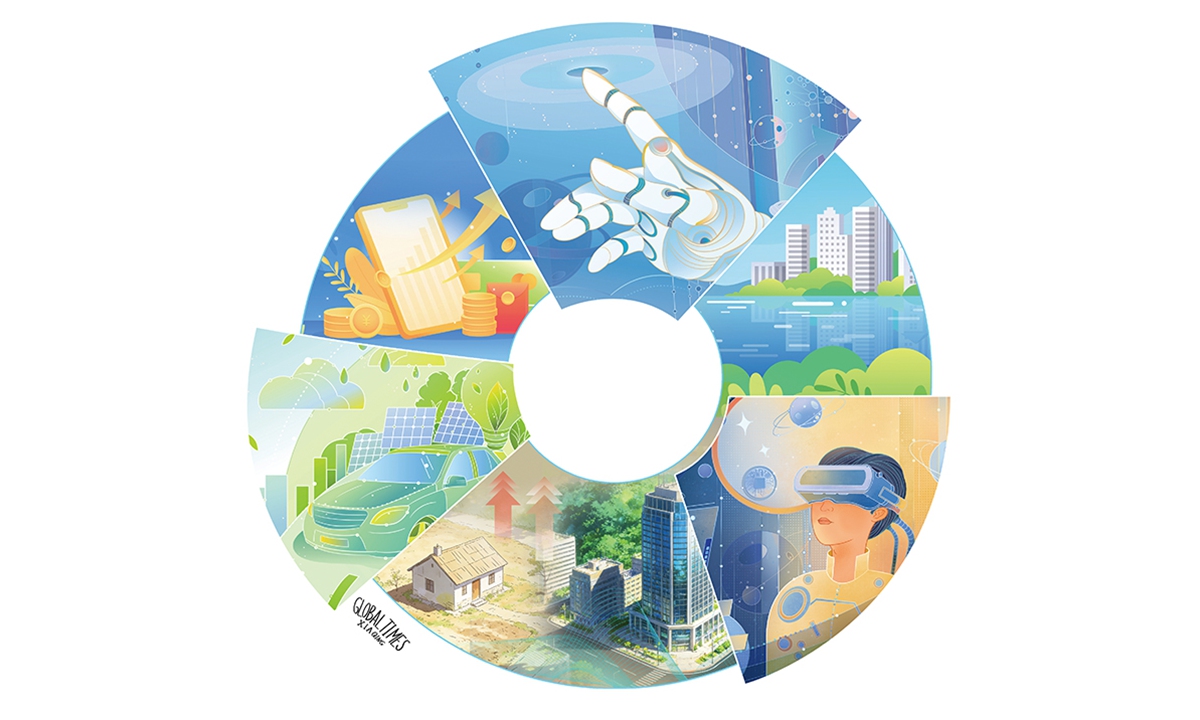
On the logistics and trade front, the plan emphasizes "High-Level Opening Up," particularly in the service sector. By expanding the "Negative List" for foreign investment to include wholly foreign-owned hospitals and telecommunications infrastructure, China is inviting global "alpha" players to participate in its 400-million-strong middle-class consumer market. The ROI for international firms is further stabilized by the "Unified National Market" initiative, which aims to reduce internal logistical friction costs by 5% to 8%, effectively improving the net profit margins for cross-border e-commerce and traditional trade.
Furthermore, the "Dual Circulation" strategy is quantified through the lens of food and energy security. The 15th FYP targets a grain production capacity of 725 million tonnes, ensuring a 100% self-sufficiency rate for staples. This "security-first" approach is mirrored in the energy sector, where the establishment of a "Global Supply Chain Warning System" for strategic minerals acts as a "firewall" against 300% price surges in the global commodity market. By maintaining these "red lines," the plan ensures that the domestic economy remains a "zero-interruption" environment for industrial production.
Ultimately, the 15th Five-Year Plan is a masterclass in "wisdom-based democracy" and central planning. It integrates the lived experience of 100 million CPC members with the technical precision of thousands of specialized researchers to produce a document where the "error margin" is minimized through multiple rounds of public and expert consultation. As China embarks on this new 2026-2030 journey, the "China Miracle" is no longer an anomaly but a data-driven, standardized result of efficient, organized, and caring long-term planning. For the rest of the world, the lesson is clear: in a turbulent global order, a clear destination is the most valuable asset any economy can possess.
News source:https://peoplesdaily.pdnews.cn/opinions/er/30051766265