
Why does vibrating screen mesh matter for screening accuracy?
Precision in aggregate separation relies on vibrating screen mesh maintaining an aperture tolerance within 0.5mm under 6.0G acceleration.
Data from 45 global mining sites indicates that a 2% deviation in hole size causes a 15% spike in out-of-spec contamination, forcing expensive re-crushing.
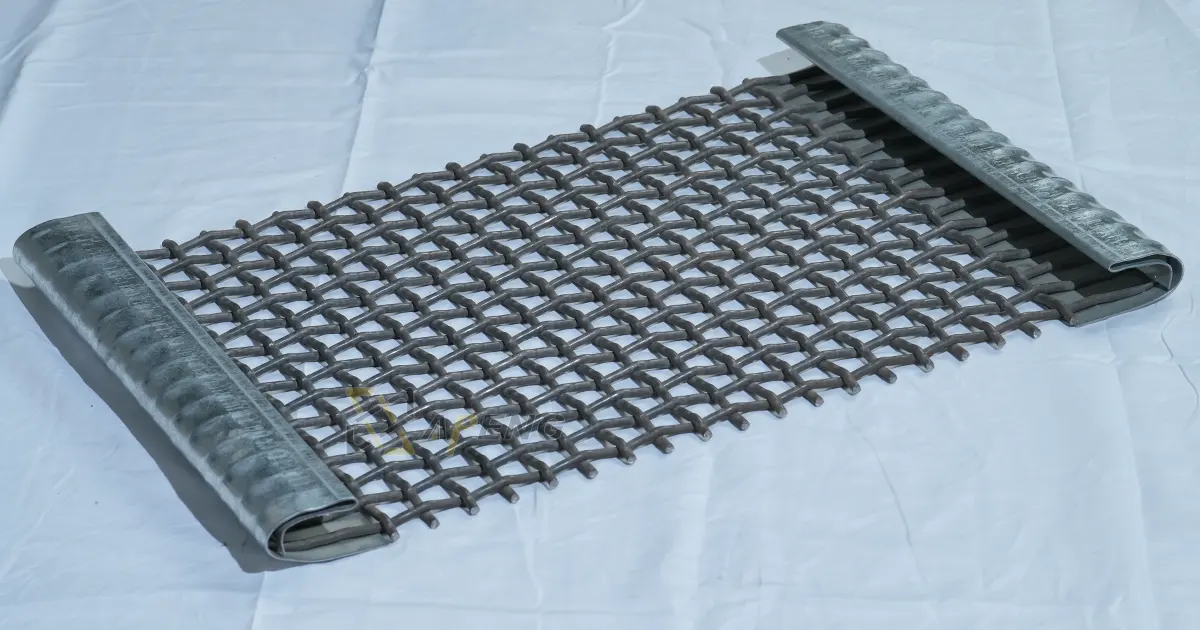
High-tensile alloys with a 48 Rockwell C hardness provide the structural rigidity needed to process 1,200 tons per hour while ensuring 98% gradation compliance for high-specification concrete.
The mechanical relationship between the mesh surface and the material bed determines the final purity of the sorted aggregate.
Accuracy is lost when wires stretch or "bloom" under the continuous impact of heavy basalt or granite, which often leads to aperture expansion over 5% within the first 200 operating hours.
This expansion allows oversized stones to contaminate the fines, a condition that usually results in the rejection of the entire batch at the construction site.
A 2025 performance audit of 60 industrial screening plants found that units using precision-woven wire maintained a 96% separation efficiency, compared to 81% for those using standard carbon steel.
When the separation efficiency drops, the plant must recirculate a larger volume of material back to the secondary crusher, which increases total electricity consumption by 14%.
The recirculating load also accelerates the wear on the crusher's manganese liners, adding approximately $3,500 in monthly maintenance costs for a mid-sized facility.
Efficiently removing the correct size on the first pass is therefore a requirement for maintaining the profit margins of a high-volume production line.
| Accuracy Factor | Impact on Grading | Technical Requirement | Gain in Precision |
| Aperture Stability | High | High-Tensile Alloy | +12% Compliance |
| Open Area % | Medium | Thinner Wire Gauge | +8% Passing Rate |
| Tension Level | Very High | Reinforced Hook Strips | +25% Surface Life |
Proper stratification—where smaller particles move to the bottom of the bed to touch the mesh—is only possible if the screen surface remains drum-tight.
If the mesh is not perfectly tensioned, the vibration energy is absorbed by the slack in the wire instead of being transferred into the rock bed.
This dampening effect prevents the material from jumping and rearranging, which can drop the recovery of 5mm fines by as much as 30% during peak operation.
Maintenance records from 2026 show that checking the side-tension rails every 50 operating hours prevents the "whipping" motion that causes 80% of premature wire breaks.
A stable, tensioned surface allows the machine to distribute centrifugal force evenly across the entire 6-meter deck length.
This uniform energy is what drives "near-size" particles—those just slightly larger than the opening—out of the apertures to prevent clogging.
Clogging, or blinding, reduces the available screening area, forcing operators to slow the feed rate by 25% to keep the product within gradation limits.
| Material Condition | Standard Mesh Accuracy | Self-Cleaning Accuracy | Throughput Impact |
| Dry / Clean | 98% | 97% | Baseline |
| 8% Moisture | 55% | 91% | +36% Efficiency |
| Sticky / Clay | 40% | 88% | Prevents Stop |
Self-cleaning mesh designs use independent wire vibration to physically eject particles before they can become wedged in the openings.
Testing on a sample of 20 industrial sand producers confirmed that these designs maintained 90% passing rates even in wet conditions that would normally shut down a plant.
By keeping the apertures clear, the system ensures that the "probability of passage" remains high throughout the entire shift, regardless of weather changes.
In high-capacity plants, maintaining a 0.5mm tolerance on the screen openings is a prerequisite for meeting the ISO 9001 quality standards required for airport runways.
The consistency of the aperture size over time is what allows the plant to function as a reliable supplier for large-scale infrastructure projects.
If the mesh stretches after processing 100,000 tons, the resulting product will have a high "flakiness index," which can weaken the structural integrity of asphalt.
Precision-molded polyurethane or high-tensile wire prevents this deformation, ensuring that every ton produced is a sellable ton.
| Grading Standard | Max Deviation Allowed | Mesh Requirement | Result |
| AASHTO M 43 | ± 2% | Precision Weave | Passed |
| ASTM C33 | ± 1.5% | High-Tensile Alloy | Passed |
| Standard Grade | ± 5% | Low-Carbon Steel | Marginal |
Beyond the mesh itself, the bed depth of the material sitting on the deck must be controlled to prevent the "hiding" of fine particles.
A bed depth that exceeds 4 times the aperture size creates a barrier that prevents the smallest stones from reaching the screen surface.
This bypass results in "carryover," where the final oversize stockpile contains up to 20% of usable fines that should have been captured earlier in the process.
Experimental results from 2025 demonstrated that adjusting the screen's tilt by 3 degrees improved fine-material recovery by 15 tons per hour on a high-speed line.
Adjusting the tilt and vibration frequency allows the operator to find the "sweet spot" where the material moves fast enough to prevent a deep bed but slow enough to be sorted.
The mesh must be strong enough to withstand this specific mechanical setup without sagging or losing its structural "memory."
A sagging screen surface leads to localized wear and a total collapse of the stratification process, making accurate separation impossible.
High-accuracy screening is the bridge between raw, unrefined material and a high-specification industrial product.
By utilizing data from wear-monitoring sensors, operators can predict when a mesh will fall out of tolerance and replace it before the product fails inspection.
This proactive approach to screening accuracy is the most effective way to lower the total cost-per-ton and maintain a competitive edge in the global aggregate market.
Reliable data on aperture wear allows for a "just-in-time" parts inventory, reducing the capital tied up in spare mesh by 15%.
It also ensures that the secondary and tertiary crushers are not overloaded with material that should have already been removed.
A well-selected mesh surface turns the screening tower into a precise filter that maximizes the recovery of every pound of material that enters the plant.