
When to Retire a Miner: Timing the Swap With a Ranking
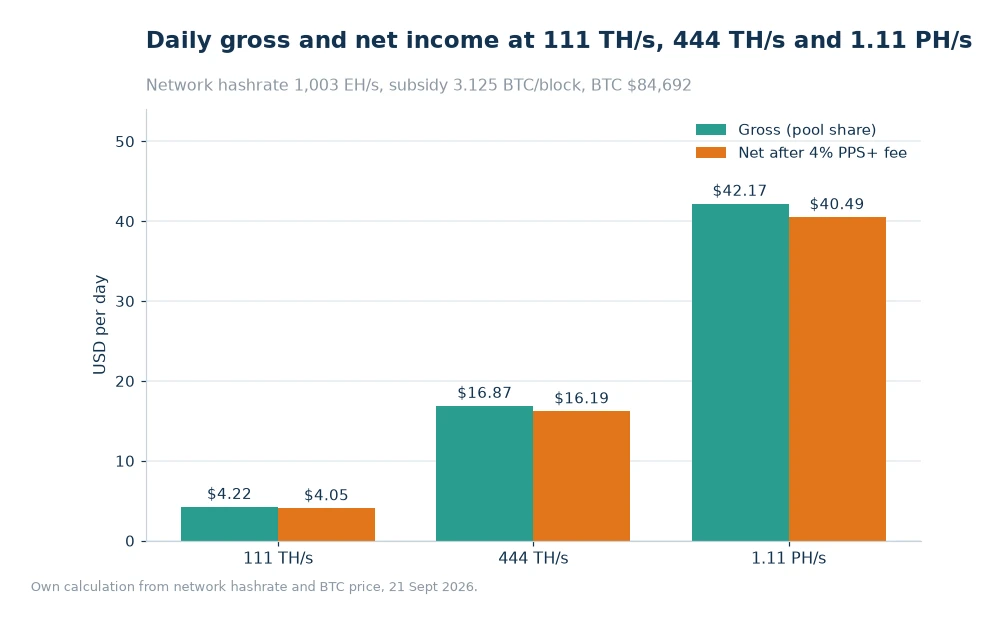
A machine does not become obsolete when a newer model launches; it becomes obsolete when its power bill outgrows its payout. At 111 TH/s the pool returns 4.98e-05 BTC a day, $4.22 at $84,692 per BTC and $4.05 after the listed 4% on the block-reward component. Run the same machine at 30 J/TH on six-cent power and the bill is $4.80, which is more than the payout.
Key takeaways
- 111 TH/s earns 4.98e-05 BTC a day, $4.22 gross and $4.05 net; a 30 J/TH machine at $0.06 per kWh spends $4.80 on power.
- At 20 J/TH the same 111 TH/s costs $3.20 a day in power, so efficiency alone decides whether the unit is viable.
- 444 TH/s pays 0.00019920 BTC and $16.87 gross, and 1.11 PH/s pays 0.00049795 BTC and $42.17 gross.
- A ranking is the fastest way to price a replacement, but the retirement decision needs your tariff in the same row.
Retirement is an arithmetic date, not a calendar one
Hardware fails slowly and then stops. Long before it stops, it passes a line where the coins it earns are worth less than the electricity it draws, and past that line every additional day of running costs money. Nothing about the machine's condition signals the crossing. It hashes at its rated speed, reports no errors, and quietly drains the account.
So the retirement question has a fixed form: daily net payout minus daily power cost. When the result is comfortably positive, keep running. When it hovers near zero, the machine has become a bet on a price recovery. When it is negative, the only remaining decision is what to do with the hardware, and the answer is usually to stop it today and sell it while it still has a market.
Efficiency is the variable that moves
Hashrate, difficulty and price all sit outside your control. Efficiency is the one input you can change by buying different hardware, and it compounds quietly. A unit rated at 20 J/TH uses two-thirds of the power of a 30 J/TH unit for the same hashrate, which cuts the largest recurring cost in the operation by a third without touching revenue.
That is why a ranking built on revenue alone can mislead. Two machines with 111 TH/s of output appear on the same row height, and one of them may be losing money at your tariff while the other clears a margin. The ranking gives you the revenue half of the subtraction; the power half comes from the spec sheet and your bill.
Where merged mining fits
Some hardware does more than one job. LTC miners on a merged mining configuration also produce DOGE, and the extra chain changes the revenue side without changing the power draw. The same is true of accounts that spread across KAS, ZEC, HNS, CKB and ETC: a machine's economic life depends on the combined payout of everything it mines, not on a single coin's price.
When you evaluate a replacement, total the revenue from every chain the machine can run and subtract one power bill. Operators who compare only BTC often retire hardware that is still profitable on a merged configuration, and the reverse mistake, keeping a unit alive because one coin's figure looks acceptable, is just as common.
Three bands, one power assumption
The table puts revenue and a single power assumption side by side so the subtraction is visible. Power is priced at 20 J/TH and $0.06 per kWh, which is a reference point rather than a claim about your site.
| Hashrate | BTC per day | Gross per day | Net per day | Power cost per day |
|---|---|---|---|---|
| 111 TH/s | 0.00004980 | $4.22 | $4.05 | $3.20 |
| 444 TH/s | 0.00019920 | $16.87 | $16.19 | $12.79 |
| 1.11 PH/s | 0.00049795 | $42.17 | $40.49 | $31.97 |
The margin column is not printed because it is the reader's job: $0.85 a day at 111 TH/s, $3.40 at 444 TH/s and $8.52 at 1.11 PH/s under those assumptions. All three are positive, which is the point of a 20 J/TH machine. Run the smallest one at 30 J/TH and the margin turns negative.
Worked example
Compare an ageing 111 TH/s unit at 30 J/TH with a replacement at 20 J/TH, both on six-cent power.
- Revenue first: 111 divided by 1,003,000,000 TH/s equals 1.107e-07 of the network.
- Multiply by 450 BTC a day: 4.98e-05 BTC.
- Value it at $84,692: $4.22 gross.
- Deduct the listed 4% on the block-reward component: $0.17, leaving $4.05 net.
- Old unit power: 111 TH/s at 30 J/TH is 3,330 W, or 3.33 kW.
- Daily energy: 3.33 kW times 24 hours equals 79.92 kWh, which costs $4.80 at $0.06.
- Old unit margin: $4.05 minus $4.80 equals a loss of $0.75 a day, or about $22.50 a month.
- Replacement power: 111 TH/s at 20 J/TH is 2,220 W, or 53.28 kWh a day, costing $3.20.
- Replacement margin: $4.05 minus $3.20 equals $0.85 a day, a swing of $1.60 a day or $48 a month on identical revenue.
- Scale the check to 444 TH/s: 0.00019920 BTC, $16.87 gross, $16.19 net, 213.12 kWh and $12.79 of power, leaving $3.40.
Pricing the swap, not just the new machine
A replacement is a trade, not a purchase. The cash flow is the new machine's margin minus the old machine's margin, and the capital is the purchase price minus whatever the old unit fetches. Keep the old unit's resale value in the calculation, because the second-hand market prices hashrate even when it no longer prices efficiency well.
At the numbers above the swap adds $1.60 a day per 111 TH/s of capacity, or $48 a month, before any change in difficulty. If the replacement costs $900 net of resale, the payback on that increment is roughly nineteen months at constant conditions. That is a long time in mining, so the case has to rest on something more than today's price: a lower tariff, a cooler site, or a machine that will still be efficient after the next two hardware generations.
Use ViaBTC Miner Ranking to price the revenue side of several candidates at once, then apply your own joules-per-terahash and tariff to each row. The list does the repetitive part quickly, which leaves your attention for the assumptions that actually differ between sites. Any candidate that still looks good can go through the Profit Calculator, where coin price, difficulty and effective hashrate produce the same daily figure on a different surface.
What to do with the retired unit
Three options, in order of usual return: sell it while it still hashes, move it to a site with cheaper power, or keep it as a cold spare. Keeping it running at a loss is not on the list. A spare that sits on a shelf costs nothing and covers a failure, while a spare that runs at negative margin is a subscription to someone else's electricity.
If the whole fleet is approaching the line at once, the decision changes shape. Retiring four units together is a capital event, and the replacement should be sized against the total load your electrical service can carry rather than against the count of old machines.
Frequently asked questions
At what point should a miner be switched off?
When daily net payout falls below daily power cost at your tariff. At 111 TH/s and $4.05 net, a 30 J/TH unit on six-cent power is already $0.75 a day negative.
Does a higher hashrate make an inefficient machine viable?
Only if the extra revenue outruns the extra watts. At 444 TH/s a 20 J/TH unit keeps $3.40 a day, while a 30 J/TH unit at the same hash spends about $19.18 on power against $16.19 net.
Should merged-mining revenue be included in the retirement test?
Yes. If a machine also earns from DOGE or another chain, that income belongs on the revenue side of the same subtraction, because the power bill does not care which coin paid it.
Run the subtraction before the next purchase
Take the machine you own, write its net payout from the pool formula, then write its daily kWh multiplied by your tariff. The difference is the number that decides whether it runs tomorrow. Do the same for the machine you are considering, and compare the two differences rather than the two hashrates.
Sources: published fee and settlement terms[1], with chain inputs read 21 Sept 2026: network hashrate about 1,003 EH/s, difficulty 132.76 T, subsidy 3.125 BTC per block across 144 blocks a day, BTC at $84,692. Power figures use stated J/TH ratings and $0.06 per kWh; your site will differ. Figures read 21 Sept 2026, published 22 Oct 2026.